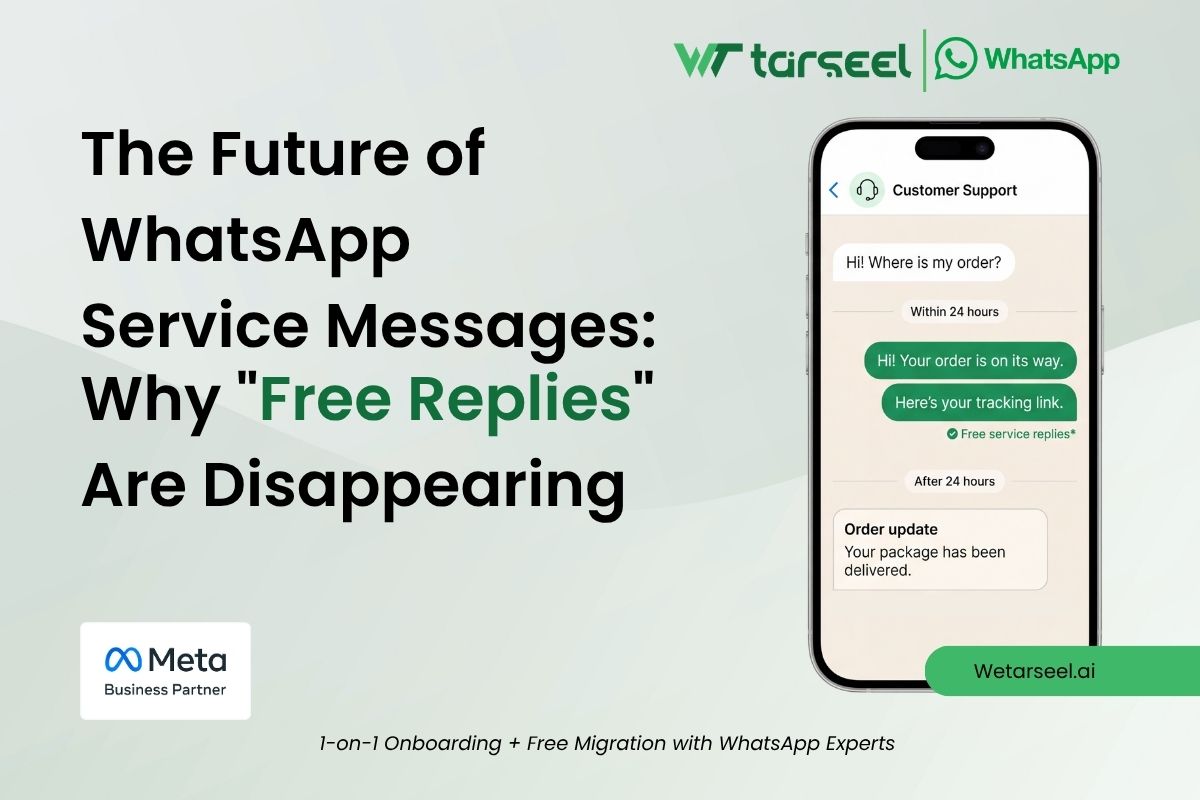
On October 1, 2026, one of WhatsApp’s best-known free features quietly switched off. It is not coming back.
For two years, businesses could reply to any customer, as many times as they wanted, for free. That era just ended. And once you look at the full pattern, not just this one change, it becomes clear this isn’t a one-time price hike. It’s the future of WhatsApp service messages taking shape in real time.
This article isn’t a rate card. For exact numbers by country, we’ve already broken that down in our complete WhatsApp API Pricing guide. This piece answers a different question: where is this all heading, and what should your business do about it?
Quick Recap: What Just Changed
Since November 2024, replies inside WhatsApp’s 24-hour customer service window were free and unlimited. Businesses built entire support teams and chatbots around this idea.
From October 1, 2026, that changes:
- You get 1,000 free service replies per phone number, per month. After that, every reply is billed.
- Utility messages (like order updates) sent inside the chat window are no longer free either.
- A separate, brand-new charge for Meta’s own AI, called Meta Business Agent, started even earlier, on August 1, 2026.
In one line: WhatsApp didn’t just raise a price. It ended the idea that replying to a customer is free.
If you want the full country-by-country breakdown for Pakistan, UAE, and the rest, read our pricing guide here. Keep reading here to understand why this happened, and what’s likely coming next.
Why Is Meta Doing This Now?
Here’s the part most articles skip: this change isn’t random. It lines up almost perfectly with something else Meta just launched: its own AI.
On June 3, 2026, at Meta’s Conversations conference in London, Meta announced Meta Business Agent, a built-in AI that replies to customers on WhatsApp, Messenger, and Instagram automatically, day or night. According to Meta’s own announcement, more than one million businesses were already using an early version before this global launch.
Two months later, Meta started charging for it. Two months after that, it stopped free-form human replies from being unlimited too.
That timing is not a coincidence. Meta makes money from WhatsApp mainly through business messaging. For years, “free replies” was the one part of that system Meta gave away. Now that Meta has its own paid AI product to offer as an alternative, giving away free replies stops making business sense for Meta.
A recent Gartner-cited industry survey found that 91% of customer service leaders feel real pressure from their own leadership to adopt AI in 2026. Meta isn’t just reacting to that pressure. It’s positioning itself to profit from it.
This is the real story behind the future of WhatsApp service messages: Meta is nudging every business on the platform toward one of two paths: pay more for the human/chatbot replies you’re already sending, or start paying Meta directly for its own AI instead.
The Pattern: A Timeline of Shrinking “Free”
Look at this timeline, and the direction becomes obvious.
-
Businesses paid one flat fee per 24-hour conversation.
Signal: simple, but blunt pricing.
-
Service replies became fully free and unlimited.
Signal: Meta encourages heavy WhatsApp usage.
-
Billing switched to “per message,” not per conversation.
Signal: more precise pricing, but also more billable moments.
-
Meta launches its own AI, Meta Business Agent.
Signal: Meta enters the AI-agent race directly.
-
Meta Business Agent replies start being billed by the token.
Signal: Meta’s AI is a paid product, not a free perk.
-
Free service replies get capped at 1,000 per month, per number.
Signal: the “free chat” era formally ends.
Every step moves in the same direction: WhatsApp is charging for more of the conversation, not less. This isn’t likely to reverse. If anything, the more useful WhatsApp becomes for business (and it keeps getting more useful), the more Meta has reason to charge for that usage.
A Real-World Example: How This Plays Out
Picture a mid-sized online clothing store in Lahore. Before October 2026, their support team replied to every customer question for free: order status, sizing questions, return requests. Hundreds of replies a day, no cost beyond their support software.
After October 1, here’s what happens to that same store:
- They get 1,000 free replies per number, per month, about 33 a day.
- Their actual volume is closer to 90 replies a day.
- That means roughly 57 replies a day, or about 1,700 a month, are now billed at the utility message rate.
Nothing about their customer service changed. Their bill did.
This is exactly the situation the pricing guide walks through in detail, with the actual per-country rates you’d multiply this by.
What This Means for the Future of Your WhatsApp Strategy
This is the part that actually matters for your business. A few shifts to make now:
1. Audit your reply volume today, not next quarter. Most businesses have never counted how many free-form replies they send a month, because it never mattered before. It matters now. If you’re over 1,000 per number, you’re already paying more than you think.
2. Click-to-WhatsApp ads just became more valuable. When a customer starts a chat by tapping a Facebook or Instagram ad, WhatsApp opens a 72-hour free window, and this one is untouched by the October changes. In a world where regular replies now cost money, this is one of the few genuinely free doors left open. Expect more businesses to lean into ad-driven WhatsApp traffic specifically because of this.
3. Decide, deliberately, who replies: a human, a simple chatbot, or Meta’s AI. These three now have three different cost structures. A human or your BSP’s chatbot: billed per message, past your free quota. Meta Business Agent: billed per token, no free quota at all inside the 24-hour window in most cases. Getting this wrong means paying for the wrong kind of automation.
4. Templates are becoming more attractive again, not less. Utility and authentication templates get cheaper as your volume grows. That’s a real volume discount. Free-form service replies never do. If a message is repeatable (an order update, a reminder), turning it into an approved template may now cost less than a “free” human reply.
Quick gut check: if your support team replies to more than ~33 customers a day, per WhatsApp number, you’re past the free quota. That’s the line that matters now.
Where WhatsApp Pricing Is Probably Headed Next
Based on the pattern above, and on how Meta has talked about its own roadmap, a few reasonable predictions:
- More usage will get priced, not less. In joint research with BCG, Meta reported that businesses weaving messaging into every stage of the customer relationship, not just support, saw customer lifetime value roughly double. That’s a strong incentive for Meta to keep investing in, and monetizing, this channel further.
- Meta’s AI will likely stay cheaper to use than human replies, over time. Meta has an obvious incentive to make its own AI agent the more cost-effective choice, since it captures that revenue directly instead of splitting it with BSPs.
- More countries will likely get their own standalone rate cards. October’s update already moved 9 countries out of shared regional pricing groups. Expect this list to keep growing as Meta fine-tunes pricing market by market.
- Free entry points (like the 72-hour ad window) will probably stay protected. Meta still needs businesses to buy Facebook and Instagram ads. That’s a core revenue line Meta has every reason to keep attractive.
None of this is guaranteed. But it’s a consistent enough pattern that “wait and see” is a riskier strategy than building your WhatsApp budget around continued, gradual monetization.
Frequently Asked Questions (FAQs)
-
Is WhatsApp becoming too expensive for small businesses?
Not necessarily. Low-volume businesses, under 1,000 replies a month per number, are barely affected. The change mostly hits businesses running high-volume, always-on chat support.
-
Should I switch to Meta Business Agent to save money?
Not automatically. Meta Business Agent is billed by tokens, with no equivalent of the 1,000-free-reply quota in most setups. For many businesses, a BSP-built chatbot combined with the free quota is still cheaper. Compare both against your actual volume before switching.
-
Does this mean WhatsApp is a worse channel for business than before?
No. It means WhatsApp is maturing into a paid infrastructure layer, the way most communication tools eventually do (think email marketing platforms, or SMS gateways). It still has some of the highest open rates of any messaging channel; it's just no longer free to run at scale.
-
Where can I see the exact new rates for my country?
Our WhatsApp API Pricing guide has the full country-by-country breakdown, including Pakistan and UAE. View Here
The Bottom Line
WhatsApp isn’t becoming unaffordable. It’s becoming a channel where every message has a cost, and every business needs a plan.
The businesses that adapt fastest, auditing their reply volume, leaning into Click-to-WhatsApp ads, and choosing the right mix of human, chatbot, and AI replies, will spend less than the ones still assuming replies are free.
Free replies were never a permanent feature. They were a launch incentive. That incentive has now run its course. Understanding that is the real key to planning for whatever WhatsApp pricing does next.