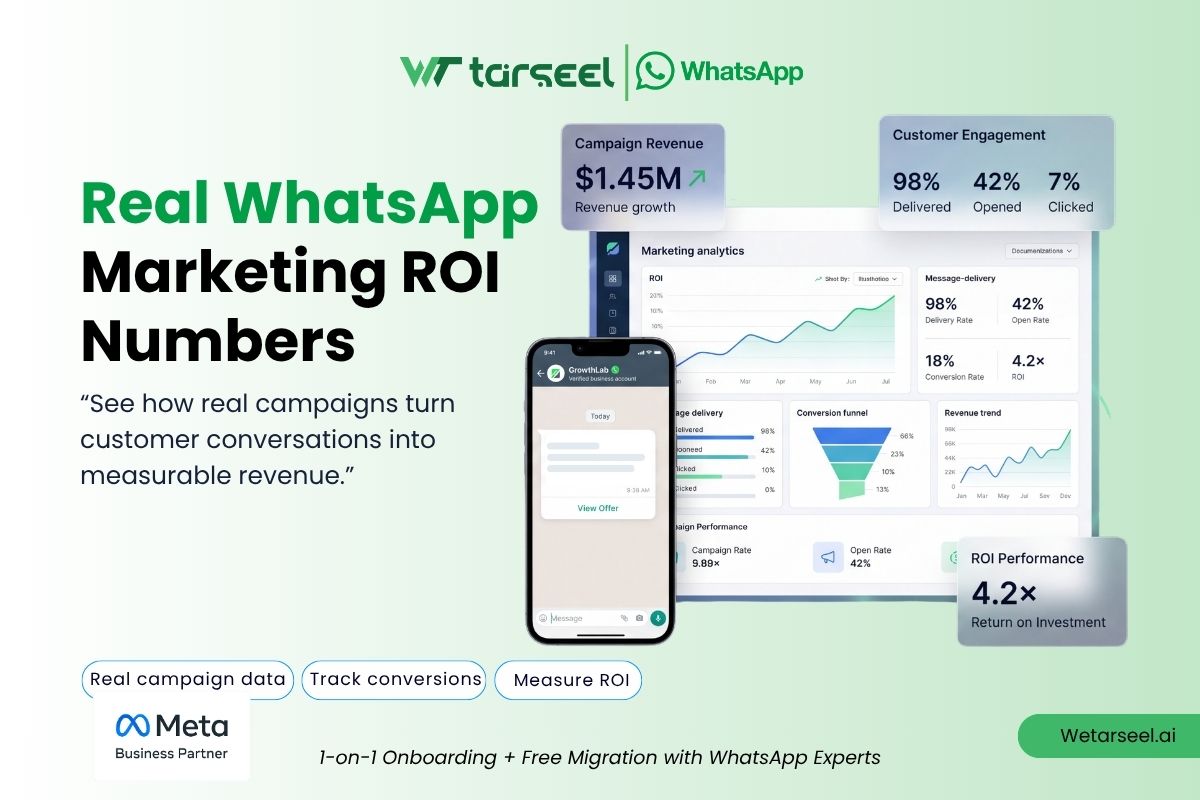
One dollar in. Fifty-eight dollars back.
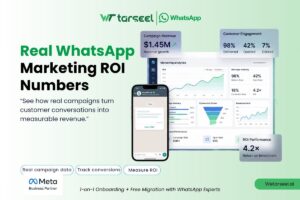
That’s not a typo. It’s the real WhatsApp marketing ROI some brands are pulling in right now, and it’s why so many marketers are moving their budgets to this channel.
Here’s the problem, though. Most “WhatsApp ROI” articles online just throw big numbers at you with no source, no context, and no real case study behind them. This article is different. Every number here comes from a named source, a real campaign, or a documented benchmark study. No guesses. No made-up stats.
Key takeaways:
- Real-world WhatsApp ROI ranges from 3x to over 100x depending on the industry and campaign type.
- Beauty and cosmetics brands see the highest returns of any vertical, around $58 back for every $1 spent.
- Abandoned cart recovery flows regularly cross 100x ROI.
- List quality, not the channel itself, is the single biggest driver of these numbers.
Table of Contents
Why WhatsApp ROI Numbers Are So Hard to Trust
Before the real numbers, a quick word on why this topic gets confusing so fast.
Most WhatsApp marketing platforms publish their own “ROI stats.” That’s not automatically wrong, but it means the number often comes from the company trying to sell you the tool. So in this article, every stat is labeled with its source, and vendor claims are flagged as vendor claims, not treated as independent research.
Simple rule to remember: if an article gives you a big ROI number with zero source, zero brand name, and zero explanation, don’t trust it.
What “WhatsApp Marketing ROI” Actually Means
Let’s keep this simple. ROI just means: for every rupee, dollar, or dirham you spend, how much do you get back?
In WhatsApp marketing, this is sometimes called ROWS, short for Return on WhatsApp Spend. Industry benchmark guides now treat this as the single most important metric to track, with typical benchmarks sitting between 15x and 60x across industries, and abandoned cart recovery flows often crossing 100x.
Here’s why WhatsApp performs so differently from other channels:
- Open rates are huge. Vendor benchmarks consistently report around 98% open rates on opted-in marketing messages, and independent benchmark studies confirm the real-world measurable range sits close to that, with about 80% of it actually trackable.
- Messages get read fast. Data from marketing platform Chatarmin shows around 80% of WhatsApp messages get opened within the first five minutes of being sent.
- People are willing to buy through it. Chatarmin’s 2026 benchmark data found that 70% of consumers say they’re more likely to buy from a brand they can message directly, and separately, 66% of consumers report making a purchase after interacting with a brand on WhatsApp.
That combination of near-total open rates, fast reads, and high buying intent is exactly why the ROI numbers on this channel look so different from email or SMS.
The Real Benchmark Numbers (Table)
Real, source-verified ROI and performance benchmarks for WhatsApp marketing, compiled from independent 2026 industry studies.
| Metric | Real-World Range | Source |
|---|---|---|
| 📬Average open rate | 93% to 98% | Kanal, 2026 |
| 🖱️Click-through rate (CTR) | 15% to 25% Highest in beauty and fashion, lowest in electronics |
Kanal, 2026 |
| 📈General ROI benchmark | 15x to 60x | WizMessage / Chatarmin, 2026 |
| 🛒Abandoned cart flow ROI | 100x+ | Chatarmin, 2026 |
| 💄Beauty and cosmetics vertical ROI | ~$58 per $1 spent Highest of any vertical |
Kanal, Q1 2026 |
| 📧ROI vs. email marketing | 5x to 8x higher | JestyCRM, 2026 |
| 💰Customer acquisition cost vs. email | 67% lower | JestyCRM, 2026 |
| 📊Revenue per broadcast message | $2 to $6 per recipient | WizMessage, 2026 |
Figures are aggregated 2026 vendor and industry benchmark data. Actual results vary by list quality, industry, and campaign type.
A few of these deserve real explanation, so let’s break down the case studies behind them.
Case Study #1: Takko Fashion, Turning In-Store Shoppers Into a WhatsApp List
The problem: Takko Fashion, a European retail chain, wanted to turn walk-in shoppers into a digital audience without a clunky sign-up form.
The fix: Customers scanned a barcode at checkout or in-store and joined the brand’s WhatsApp list in seconds. The signup linked straight to the CRM, so Takko knew exactly which customer joined, when, and at which store. In return, shoppers got a coupon sent straight to WhatsApp.
The result: According to Chatarmin’s documented case study, Takko’s subscriber list grew significantly, and in-store revenue jumped 82% during active campaign periods. In a comparable retail campaign tracked by the same platform, the return on ad spend hit 36.8x, meaning nearly 37 units came back for every 1 unit spent.
Why this matters for you: You don’t need a big budget to copy this. Even a small shop can build a simple “scan to join WhatsApp, get 10% off” flow at checkout. The lesson from Takko: offline foot traffic converts better into WhatsApp subscribers than into email signups, because there’s no password field, no app download, and no friction.
Case Study #2: Indian D2C Brands, the 200-300% ROI Jump
The source: AiSensy, a WhatsApp Business API platform, tracked results across Indian direct-to-consumer (D2C) brands, including a documented case study with NMIMS, a business school that studied the data.
The number: Indian D2C brands reported a 200% to 300% ROI lift from WhatsApp marketing compared to traditional marketing channels.
The bigger shift: More interesting than the ROI number itself is where the leads are now coming from. The same research found around 57% of new leads for these brands now arrive through automated WhatsApp flows rather than traditional lead channels.
That second stat is the real story. WhatsApp isn’t just converting better here. It’s quietly becoming the main lead channel for these businesses, not a side channel.
Case Study #3: Why Beauty Brands See the Highest ROI of Any Industry
If you’re wondering why beauty and skincare brands keep showing up in every “best ROI” list, here’s the actual number: aggregate data from marketing platform Kanal, covering Q1 2026, found the average WhatsApp marketing ROI for beauty and cosmetics brands was around $58 for every $1 spent, the highest of any vertical measured.
Why does beauty perform so well? Two simple reasons:
- Repeat purchase patterns. People don’t buy skincare once. They run out and buy again. WhatsApp reminders like “your serum is probably running low” land perfectly in that repurchase window.
- Higher average order value (AOV). Combined with strong repeat behavior, this pushes total ROI well above other categories.
If you run any repeat-purchase business, beauty, supplements, pet food, coffee, this is the model to copy: automated “you’re probably running low” flows on WhatsApp.
Case Study #4: Click-to-WhatsApp Ads (CTWA), the Fastest-Growing Ad Format on Meta
This channel is exploding right now, and the numbers back it up.
According to Meta’s own investor briefing for Q1 2026, click-to-WhatsApp ad spend grew 82% year-over-year between Q1 2025 and Q1 2026, making it the fastest-growing ad format across the entire Meta ecosystem.
Here’s what the performance actually looks like:
- Click-through rate: Meta’s own Marketing Science data shows CTWA ads get a 3% to 6% average click-through rate, roughly two to three times higher than a normal click-to-website ad.
- Conversation rate: Not every click becomes a real conversation, but 35% to 55% of CTWA clicks turn into an actual chat with the brand, according to Meta’s 2026 Conversations keynote data.
- Lower cost per lead: A joint Meta and BCG retail study found CTWA campaigns deliver 30% to 50% lower cost-per-acquisition than standard click-to-website campaigns for DTC brands.
- Cost varies by country: Regional benchmarks from Meta and Sinch show the average cost per conversation ranges from about $0.95 in India to $5.20 in the United States, a huge difference, so your CTWA cost will depend heavily on your market.
- Payback speed: Kanal’s aggregate data across 380 stores running CTWA found a median customer acquisition cost payback period of just 47 days.
Simple takeaway: if you’re already running Meta ads, adding a “Click to WhatsApp” button instead of sending traffic to a website could meaningfully cut your cost per lead. That’s not a guess. It’s Meta’s own reported data.
What’s Actually Driving These Numbers?
It’s tempting to think “WhatsApp equals automatic 50x ROI.” That’s wrong, and worth being clear about upfront. Every high-performing case study above shares five things in common. Missing any of these usually means a much lower ROI.
1. A clean, opted-in list
Every case study above started with real, consenting subscribers, not a scraped or bought number list. Benchmark data from Ominiflow’s 2026 report specifically notes that accounts sending to documented opt-in and segmented lists significantly outperform teams that cold-message scraped numbers, and those cold-messaging accounts instead face quality restrictions within weeks.
2. Segmentation, not blasting
Sending the same message to everyone kills your click-through rate. Kanal’s benchmark guide notes CTR climbs when brands use personalization such as the customer’s first name or last viewed product, combined with segmented sends and A/B-tested visuals.
3. Protecting your Quality Rating
WhatsApp gives every business a Quality Rating through Meta. Fall below it, and your sending limits get throttled, cutting your reach overnight. For the exact do’s and don’ts here, this guide on sending bulk WhatsApp broadcasts without getting blocked breaks it down step by step.
4. Automated flows, not just one-off blasts
The Indian D2C case study above showed 57% of leads coming through automated flows, not manual sends. Building these kinds of automated journeys, welcome flows, cart recovery, re-engagement, is covered in this breakdown of WhatsApp marketing strategies for B2B and B2C growth.
5. Official Green Tick / Blue Tick verification
Verified business accounts see higher trust, which typically means higher click and reply rates. If you haven’t gone through this yet, here’s the full Green Tick verification guide for WhatsApp Business.
How to Calculate Your Own WhatsApp Marketing ROI
Here’s a simple, honest formula, no jargon.
WhatsApp Marketing ROI = (Revenue from WhatsApp campaigns − Total campaign cost) ÷ Total campaign costTotal campaign cost should include:
- Meta’s per-message fees (marketing, utility, and authentication messages are charged; service replies are free)
- Your WhatsApp platform subscription fee
- Any ad spend if you’re running Click-to-WhatsApp campaigns
A real example, based on a published 2026 benchmark calculation from Ominiflow:
Send 10,000 marketing messages at roughly ₹0.88 each, that’s ₹8,800 in Meta fees. If 15% of recipients click through, and 5% of those clicks convert at an average order value of ₹2,000, that’s about ₹1.5 lakh in revenue, a clearly positive ROI, but only if the list is opted-in and properly segmented.
The math only works in your favor when list quality is high. Run the same math on a cold, unsegmented list, and your click-through rate can fall well below 5%, turning that same campaign into a loss.
The Pakistan Angle: What Local WhatsApp ROI Looks Like
If you’re running a business in Pakistan, the WhatsApp math looks a little different, and mostly in your favor.
According to WeTarseel’s own platform data (this is the company’s reported figure, not an independent study), Pakistani businesses typically see up to 3x higher open rates compared to email, with messages averaging a 98% open rate within five minutes of delivery. For SMEs here, the appeal isn’t just the open rate. It’s that WhatsApp already sits on almost every customer’s phone, in a market where email inboxes are often ignored.
Two customer testimonials from Pakistani businesses on the platform:
- A Shopify-based brand reported a clear increase in conversions within the first month of switching to automated WhatsApp flows for abandoned cart recovery and order updates.
- An automotive brand reported response times dropping by 60% after moving customer communication to a shared WhatsApp inbox.
Worth noting: these are individual customer testimonials, not audited case studies, so treat them as directional rather than a guaranteed outcome for your own business.
If you’re setting this up locally, the full breakdown of WhatsApp Business API pricing and setup in Pakistan covers PKR pricing, green tick approval steps, and the local compliance requirements (SECP registration, NTN, and Meta approval) you’ll need before sending your first campaign.
Common Mistakes That Quietly Kill Your ROI
Even with all this potential, plenty of businesses get low or even negative ROI on WhatsApp. Here’s what usually goes wrong:
- Sending to a cold or scraped list. This is the fastest way to trigger a low Quality Rating, get your sending limits throttled, or get banned outright.
- Using the wrong message category. Sending a promotion tagged as a “utility” message is a common rejection reason, and it can flag your account for a policy violation. This detailed list of WhatsApp Business policy violations to avoid is worth a read before your first campaign.
- No segmentation at all. One-size-fits-all blasts get lower CTR and higher opt-out rates.
- Ignoring the block rate. Industry guidance recommends keeping your block rate under 1%. Above that, campaigns should be paused immediately.
- Treating open rate as the only metric. Open rate is almost always high on WhatsApp, so that’s not where the real signal is. Revenue-based KPIs like ROWS are what actually determine your business case.
Frequently Asked Questions (FAQs)
-
What is a good WhatsApp marketing ROI?
A good general benchmark sits between 15x and 60x return on spend, based on aggregated 2026 industry data. Abandoned cart recovery flows often exceed 100x, while high-repeat-purchase categories like beauty can reach far higher on the top end.
-
Is WhatsApp marketing better than email marketing?
Based on independent 2026 data, WhatsApp marketing delivers 5x to 8x higher ROI than email marketing, along with roughly 67% lower customer acquisition costs. This is largely because of WhatsApp's near-total open rates and faster read times compared to email inboxes. For a full comparison, see WhatsApp marketing vs SMS marketing.
-
How is WhatsApp marketing ROI actually measured?
The same way as any channel: revenue generated from WhatsApp campaigns minus total campaign cost, divided by total campaign cost. The key difference is knowing your true costs. Meta charges per message by category (marketing, utility, authentication), so those fees need to be included, not just your platform subscription.
-
Do these ROI numbers apply to small businesses too, or only big brands?
The case studies above include a range of business sizes, from large D2C brands to smaller local retailers doing scan-to-join promotions. The core drivers, clean opted-in lists, segmentation, and automated flows, matter more than company size. A small shop with a genuinely engaged 2,000-person list will often outperform a large brand messaging 200,000 cold contacts.
-
What's the single biggest factor that determines WhatsApp ROI?
List quality. Every high-performing case study in this article started with real, consenting subscribers. Cold or purchased lists consistently produce the lowest ROI and the highest risk of account restrictions.
The Bottom Line
The real WhatsApp marketing ROI numbers are genuinely strong, but they’re not automatic. A 36.8x ROAS retail campaign, a 200-300% ROI jump for Indian D2C brands, and a $58-per-$1 return for beauty brands all share the same foundation: a real opted-in list, smart segmentation, and automated flows instead of one-off blasts.
If you’re weighing whether to set this up properly for your own business, this complete guide to the WhatsApp Business API is a solid next step to understand setup, approval, and how to avoid the mistakes that quietly kill ROI before a campaign even starts.